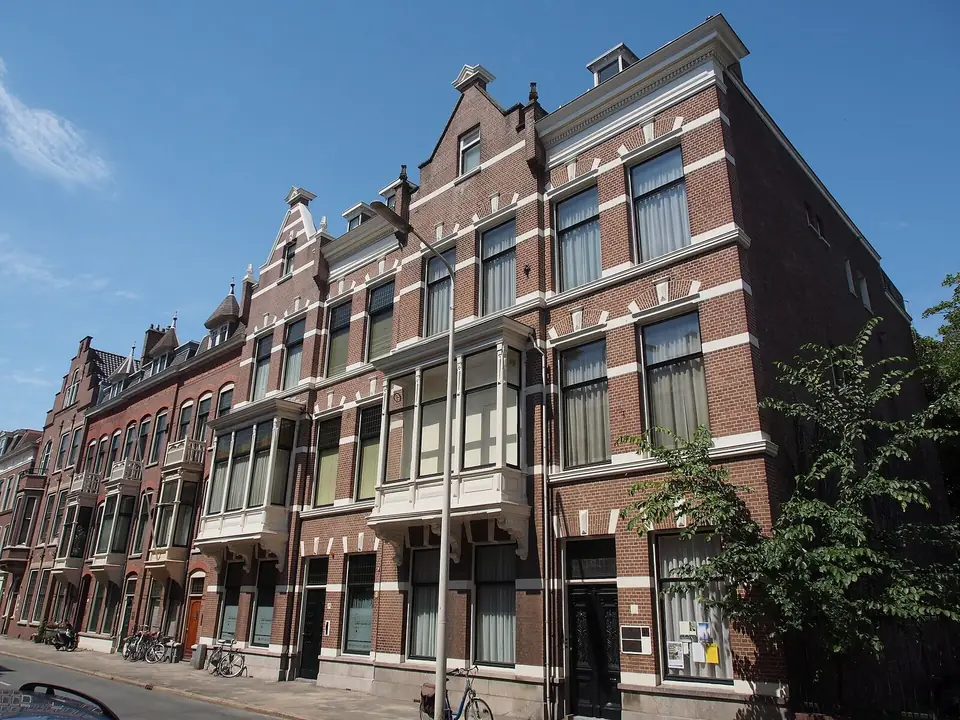

House prices in The Hague
The average existing home sold in The Hague in 2025 went for €465,418, 3% below the Dutch average of €479,527. That is 4.0% more than in 2024 and 31% more than in 2020.
The latest quarter, Q3 2026, averaged €496,537 over 2,137 sales, with prices 4.4% higher than a year earlier.
An average mixes flats and family houses, so it moves with what happened to sell. It tells you the level of the market, not what a particular home will cost.
| Year | Average sale price |
|---|---|
| 2015 |
€231,302
|
| 2016 |
€244,849
|
| 2017 |
€266,672
|
| 2018 |
€304,781
|
| 2019 |
€324,838
|
| 2020 |
€355,807
|
| 2021 |
€411,717
|
| 2022 |
€454,312
|
| 2023 |
€413,689
|
| 2024 |
€447,417
|
| 2025 |
€465,418
|
What buying the average home costs on top
At €465,418, the costs on top of the price come to about €12,677 for someone who will live in the home and borrows the full price with NHG, before the valuation, the adviser and any buying agent. A Dutch mortgage may not exceed 100% of the home's value (106% only to pay for energy-saving measures), so these costs normally come out of your savings.
| Transfer tax, 2% | €9,308 |
|---|---|
| Notary, both deeds (estimate) | €1,300 |
| Land registry, deed of transfer | €104 |
| Land registry, mortgage deed | €104 |
| NHG fee, if you use NHG | €1,862 |
| Total | €12,677 |
A buyer aged 18 to 34 who will live in the home and has not used the starter exemption before pays no transfer tax at this price, which brings the total down to about €3,369. A home you will not live in yourself, for example one you buy to let or for someone else, costs 8% transfer tax instead. Work it out for your own price.
Owning and renting in The Hague
43% of homes in The Hague are owner-occupied and 57% are rented, against 57% owner-occupied across the Netherlands. If you buy a flat you become a member of its owners' association (VvE), which maintains the building; ask for its reserve fund and maintenance plan before you bid.
The average WOZ value — the municipality's valuation, used for local taxes and in your tax return — is €383,000, against €398,000 nationally (Kerncijfers wijken en buurten 2025: the values for 2025 tax bills, which reflect prices on 1 January 2024). At the 2026 rate for owners of homes, 0.0505% of the WOZ value, the property tax (OZB) on a home of that value is about €193 a year (source). The 2026 bill itself is worked out on the home's value on 1 January 2025, which is shown on the municipality's WOZ decision.
Who lives in The Hague
The Hague had 569,468 residents on 1 January 2026. 22.7% of them have a non-Dutch nationality, against 9.3% across the country, 73,412 of them with the nationality of another EU country. Anyone with Dutch nationality, including people who also hold another, is not in that figure.
Buying a house in The Hague (Den Haag) means checking two local rules early. Many homes stand on municipal land held in erfpacht (ground lease), and the city is changing how it values that land when contracts end. And buy-to-let protection covers every neighbourhood, so a home with a WOZ value at or below the national mortgage guarantee (NHG) limit cannot be let without a permit for four years after you buy it.
Leasehold
Since 1911 the municipality has preferred to issue its land in erfpacht. In 2008 it decided to choose per case between selling land outright and issuing it in erfpacht, depending on the area and what the building is used for; the conditions were updated in 2021. So in The Hague you will meet both homes on freehold land and homes on leasehold land; the deed and the listing tell you which.
With erfpacht the municipality keeps the land and you pay ground rent (canon) for using it, unless it has been paid in advance (afgekocht, bought off). What matters for a buyer is the type of right and its end date. If you have temporary erfpacht and the contract ends, it becomes eeuwigdurende erfpacht (perpetual ground lease). The municipality wants to use one fixed method for the new land value: the WOZ value of the home from two years earlier, with the land value capped at 11% of that. It is also studying a canon percentage between 1% and 3% and a 30-year fixed canon instead of buying off. When the municipality last updated its page, in September 2026, the city council had not yet taken a final decision and was to do so only once these studies are complete; until then values are still worked out per home. If a contract ends within 15 years, only the current leaseholder, not a future buyer, can ask the municipality for early reissue, which produces an offer with the new land value and canon. This costs €750, refunded if a new contract follows. If that applies, ask the seller whether they have requested or received an offer.
You can sometimes buy the land from the municipality and become full owner. Conditions include that the home is in an area where the municipality wants to sell, that the right is a first issue or perpetual erfpacht from after 1986 with the canon bought off for the whole term, and that you live in it yourself. The price is a fixed amount set by the home's WOZ value, in 2026 from €700 for a WOZ value below €200,000 to €6,980 for €1,000,000 or more, plus possibly an extra amount if the zoning plan allows more building. Rights from before 1986 must first be reissued and bought off, for which the municipality asks a €750 contribution to the valuation costs, refunded if you take up the offer. You pay the notary, transfer tax and Kadaster costs yourself.
Buy-to-let protection
The Huisvestingsverordening Den Haag 2023 applies opkoopbescherming (buy-to-let protection) to self-contained homes in every neighbourhood of the city with a WOZ value at or below the NHG cost limit, using the latest WOZ decision available when the transfer deed is registered. For 2026 the NHG limit is €470,000. Under national law it covers only homes that, when the deed is registered, were vacant, had been let for less than six months, or were let with such a permit. For four years after registration you may only let such a home with a permit, which you can get if:
- you let it to a relative in the first or second degree, such as a parent, child or sibling
- you have lived there for at least 12 months and then let it for at most 12 months, not as a holiday let
- the home is an inseparable part of a shop, office or business premises
The municipality can also grant an exemption under a separate policy rule. Homes that have never been lived in since they were given a residential use, in practice new-build, fall outside this rule. Our guide to NHG for expats explains the limit.
Yearly charges for owners
The 2026 onroerendezaakbelasting (OZB, property tax) for owners of homes is 0.0505% of the WOZ value. On a WOZ value of €400,000 that is €202 a year. Owners also pay rioolheffing (sewerage charge), and households pay afvalstoffenheffing (waste charge); both appear on the municipal tax bill. The water board is the Hoogheemraadschap van Delfland; its bill is sent on its behalf by the Regionale Belasting Groep (RBG). Add these to the one-off costs in the costs of buying calculator.
Starter loan
The only starter loan in The Hague's regulations is the Ibb starter loan, tied to the Ik bouw betaalbaar (I build affordably) scheme, in which starters commission their own home on a plot bought for the purpose. It is up to 30% of the acquisition costs with a maximum of €30,000, and it is only for participants in a project selected under that scheme who have never owned a home. It is not a general loan for buying an existing home.
Arriving in The Hague
The Hague International Centre helps newcomers to The Hague region, and you can book an appointment there for municipal registration, which gives you your BSN, and to collect your residence permit. It has separate guidance for highly skilled migrants. See our guide to BSN and municipality registration and, if your employer applies the 30% ruling, the 30% ruling calculator.
Sources
- Gemeente Den Haag: Erfpacht en uitgiftebeleid
- Gemeente Den Haag: Nieuwe regels voor berekening grondwaarde erfpacht
- Gemeente Den Haag: Erfpachtcontract loopt af binnen 15 jaar
- Gemeente Den Haag: Van erfpacht naar eigen grond
- Lokale regelgeving: Huisvestingsverordening Den Haag 2023
- Overheid.nl: Huisvestingswet 2014, article 41
- NHG: NHG-grens in 2026 vastgesteld op €470.000
- Lokale regelgeving: Verordening onroerende-zaakbelastingen Den Haag 2021 (version from 1 January 2026)
- Gemeente Den Haag: Onroerendezaakbelasting
- Hoogheemraadschap van Delfland: Waterschapsbelasting 2026 (leaflet)
- Lokale regelgeving: Verordening Ibb starterslening Den Haag 2020
- The Hague International Centre
Questions about buying in The Hague
Can I rent out a house I buy in The Hague?
Not freely if its WOZ value is at or below the NHG cost limit, €470,000 in 2026. In every neighbourhood, such a home needs a permit to be let during the four years after the transfer, given for cases such as letting to a parent, child or sibling or a let of up to 12 months after living there for 12 months.
Is erfpacht common in The Hague?
Yes. The municipality preferred to issue land in erfpacht from 1911, and since 2008 it chooses per area between selling land and leasing it, so you will find both. When a temporary contract ends it becomes perpetual erfpacht, and the city is working on a new way to set the land value; in some areas you can buy the land if the canon has been bought off for the whole term and you live in the home yourself.
How much property tax do homeowners pay in The Hague?
In 2026 the owner's OZB is 0.0505% of the WOZ value, which is €202 a year on a WOZ value of €400,000. Owners also pay a sewerage charge, households pay a waste charge, and the Hoogheemraadschap van Delfland levies a separate water board tax.
Where the figures come from
- CBS, Bestaande koopwoningen; gemiddelde verkoopprijzen, regio (updated 17 February 2026)
- CBS, Kerncijfers wijken en buurten 2025 (updated 15 October 2026)
- CBS, Kerncijfers wijken en buurten 2026 (updated 15 October 2026)
- CBS, Bevolking; geslacht, leeftijd, nationaliteit en regio, 1 januari (updated 7 July 2026)
- CBS, Bestaande koopwoningen; verkoopprijzen, prijsindex 2020=100, regio (updated 22 October 2026)
Read from CBS StatLine on 23 November 2026; refreshed every week.