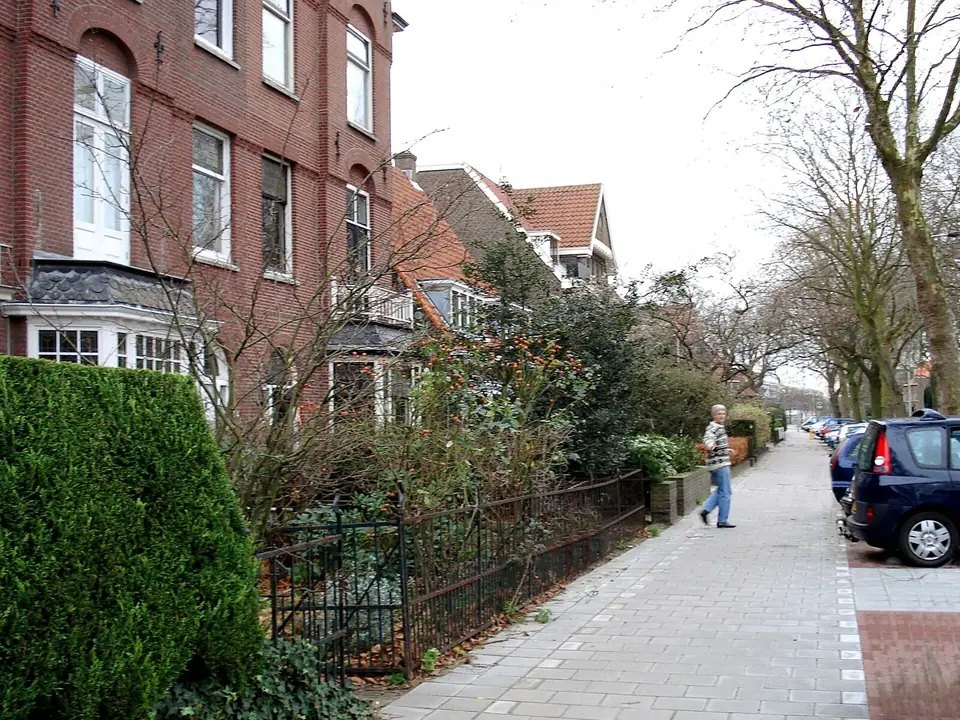

House prices in Delft
The average existing home sold in Delft in 2025 went for €453,866, 5% below the Dutch average of €479,527. That is 10.7% more than in 2024 and 34% more than in 2020.
CBS publishes quarterly prices for Zuid-Holland as a whole rather than for Delft: in Q3 2026 the province averaged €495,780, 3.8% higher than a year earlier.
An average mixes flats and family houses, so it moves with what happened to sell. It tells you the level of the market, not what a particular home will cost.
| Year | Average sale price |
|---|---|
| 2015 |
€211,971
|
| 2016 |
€224,039
|
| 2017 |
€250,075
|
| 2018 |
€282,851
|
| 2019 |
€311,299
|
| 2020 |
€339,921
|
| 2021 |
€395,478
|
| 2022 |
€417,460
|
| 2023 |
€388,177
|
| 2024 |
€409,999
|
| 2025 |
€453,866
|
What buying the average home costs on top
At €453,866, the costs on top of the price come to about €12,400 for someone who will live in the home and borrows the full price with NHG, before the valuation, the adviser and any buying agent. A Dutch mortgage may not exceed 100% of the home's value (106% only to pay for energy-saving measures), so these costs normally come out of your savings.
| Transfer tax, 2% | €9,077 |
|---|---|
| Notary, both deeds (estimate) | €1,300 |
| Land registry, deed of transfer | €104 |
| Land registry, mortgage deed | €104 |
| NHG fee, if you use NHG | €1,815 |
| Total | €12,400 |
A buyer aged 18 to 34 who will live in the home and has not used the starter exemption before pays no transfer tax at this price, which brings the total down to about €3,322. A home you will not live in yourself, for example one you buy to let or for someone else, costs 8% transfer tax instead. Work it out for your own price.
Owning and renting in Delft
37% of homes in Delft are owner-occupied and 62% are rented, against 57% owner-occupied across the Netherlands. If you buy a flat you become a member of its owners' association (VvE), which maintains the building; ask for its reserve fund and maintenance plan before you bid.
The average WOZ value — the municipality's valuation, used for local taxes and in your tax return — is €352,000, against €398,000 nationally (Kerncijfers wijken en buurten 2025: the values for 2025 tax bills, which reflect prices on 1 January 2024). At the 2026 rate for owners of homes, 0.09322% of the WOZ value, the property tax (OZB) on a home of that value is about €328 a year (source). The 2026 bill itself is worked out on the home's value on 1 January 2025, which is shown on the municipality's WOZ decision.
Who lives in Delft
Delft had 110,089 residents on 1 January 2026. 18.3% of them have a non-Dutch nationality, against 9.3% across the country, 9,459 of them with the nationality of another EU country. Anyone with Dutch nationality, including people who also hold another, is not in that figure.
Buying a house in Delft comes with two local rules worth knowing before you bid: a cheaper home cannot simply be bought to let for its first four years, and the municipality restricts turning a family home into rented rooms. Leasehold exists but is the exception, and the city still runs a starter loan for buyers aged 18 to 35.
Buy-to-let protection
Delft has opkoopbescherming (buy-to-let protection) across the whole municipality, set out in the Huisvestingsverordening Delft 2023. For four years after the transfer is registered at the Kadaster, you may not let a protected home without a verhuurvergunning opkoopbescherming (rental permit). A home is protected if its WOZ value on that date is at or below the NHG cost limit for that year, on that date it was vacant, had been let for less than six months or was let with such a permit, and it is not owned by the municipality or a housing association. Our guide to NHG for expats explains that limit.
The permit is always granted in these cases:
- you let the home to a relative in the first or second degree, such as a parent or child
- you lend the home rent-free (bruikleen)
- you have lived there yourself for at least 12 months and then let it for at most 12 months, other than as a holiday let (this is allowed only once in the four years)
- the home is part of a shop, office or business premises
Outside these cases the municipality can grant one in special cases, when it judges that letting the home outweighs keeping it for buyers. If you might move abroad for work within four years, ask what this means for you before you buy, not after.
Renting out rooms
Letting a home to three or more people who do not form a household, or taking in a lodger who rents a room without their own kitchen, toilet and shower, needs an omzettingsvergunning (conversion permit). Delft grants it only where the home is above a shop or a café or restaurant, because the city wants to keep homes available for families. No permit is needed for converting a home into at most two rooms, or for one person living in with you.
Leasehold
Erfpacht (ground lease) means the municipality owns the land and you pay a yearly fee, the canon. Delft used to issue a lot of land this way. It now does so only where its policy says so, for example in the Delftse Hout, for monuments and community buildings. The municipality publishes general conditions (algemene erfpachtbepalingen) from 1976, 1988, 1993 and 2012, so ask which set applies to the home.
For a home with perpetual erfpacht you can buy off the canon by paying the land value, and you can then convert to full ownership for a €1 land price plus €517 in administration costs. A temporary right must first be converted to a perpetual one, and the municipality then sets the land value again. For an apartment, conversion is possible only if the land was split into apartment rights before it was issued in erfpacht. The municipality notes that doing this when the home changes hands usually saves notary costs. Our Amsterdam erfpacht guide explains the general terms.
Yearly charges for owners
The 2026 onroerendezaakbelasting (OZB, property tax) for owners of homes is 0.09322% of the WOZ value. The 2026 rioolheffing (sewerage charge) has an owner's part of €209.98 and a user's part of €58.92 for the first 500 m³ of water. The reinigingsheffing (waste charge) is €283.59 for a one-person household and €444.25 for a larger one. On top of these, the water board, Hoogheemraadschap van Delfland, sends its own bill. The costs of buying calculator covers the one-off costs of buying.
Starter loan
Delft offers a Starterslening (starter loan) through SVn, the Stimuleringsfonds Volkshuisvesting. It is for first-time buyers aged 18 to 35 who live in the Netherlands and have a right of residence, buying a home in Delft to live in themselves, whether or not they live in the city now. The price may not exceed the NHG limit (€470,000 in 2026), and the loan is only available with an NHG mortgage. You can borrow up to 20% of the acquisition costs, to a maximum of €30,000, over 30 years with no monthly payments in the first three years. You first request an allocation letter from the municipality online, free of charge. For 2026 the municipality has €3,500,000 for this and three other housing loans together; once it is used up, no more loans are given. Whether a starter loan fits your finances is a question to put to a mortgage adviser.
Arriving in Delft
If you come from abroad for more than four months, you register in person at the Stadskantoor within five days of arrival, by appointment. You can book up to two months ahead, but not for a date before your rental contract starts. The Hague International Centre can also register newcomers to Delft, along with The Hague, Rijswijk and Leidschendam-Voorburg. Our guide to the BSN and municipal registration covers the documents.
Sources
- Gemeente Delft: Huisvestingsverordening Delft 2023 (lokaleregelgeving.overheid.nl)
- Gemeente Delft: Omzettingsvergunning kamerverhuur
- Gemeente Delft: Erfpacht
- Gemeente Delft: Verordening onroerendezaakbelastingen 2026 (lokaleregelgeving.overheid.nl)
- Gemeente Delft: Verordening rioolheffing 2026 (lokaleregelgeving.overheid.nl)
- Gemeente Delft: Verordening reinigingsheffingen 2026 (lokaleregelgeving.overheid.nl)
- Gemeente Delft: Starterslening
- Gemeente Delft: Verordening Starterslening gemeente Delft 2025 (lokaleregelgeving.overheid.nl)
- Gemeente Delft: Besluit vaststellen budgetplafond verordeningen stadsverbetering Delft 2026 (Gemeenteblad)
- SVn: Starterslening Delft
- Gemeente Delft: Verhuizen vanuit het buitenland
- The Hague International Centre: Formalities for your international staff members
Questions about buying in Delft
Can I buy a house in Delft and rent it out?
Not freely if the home is at the cheaper end. For four years after the transfer, a home with a WOZ value at or below that year's NHG cost limit can only be let with a municipal rental permit, which is given for cases such as letting to a parent or child, or a one-off let of up to 12 months after you have lived there for a year. Letting to three or more unrelated people also needs a conversion permit, which Delft grants only for homes above a shop or café.
Is there leasehold (erfpacht) in Delft?
Yes, but it is no longer the norm. The municipality issued a lot of land in erfpacht in the past and now does so only where its policy says so, such as in the Delftse Hout and for monuments. With perpetual erfpacht you can buy off the canon by paying the land value and then become full owner for a €1 land price plus €517 administration costs.
Can expats get a starter loan in Delft?
Delft's starter loan is open to first-time buyers aged 18 to 35 buying a home in Delft, whether or not they live in the city now. Nationality is not among the conditions, but you must live in the Netherlands, have a right of residence there and live in the home yourself. The price may not exceed the NHG limit, you need a mortgage with NHG, and the loan is at most 20% of the acquisition costs, up to €30,000. The 2026 budget is shared with other housing loans, so it can run out.
Where the figures come from
- CBS, Bestaande koopwoningen; gemiddelde verkoopprijzen, regio (updated 17 February 2026)
- CBS, Kerncijfers wijken en buurten 2025 (updated 15 October 2026)
- CBS, Kerncijfers wijken en buurten 2026 (updated 15 October 2026)
- CBS, Bevolking; geslacht, leeftijd, nationaliteit en regio, 1 januari (updated 7 July 2026)
- CBS, Bestaande koopwoningen; verkoopprijzen, prijsindex 2020=100, regio (updated 22 October 2026)
Read from CBS StatLine on 23 November 2026; refreshed every week.