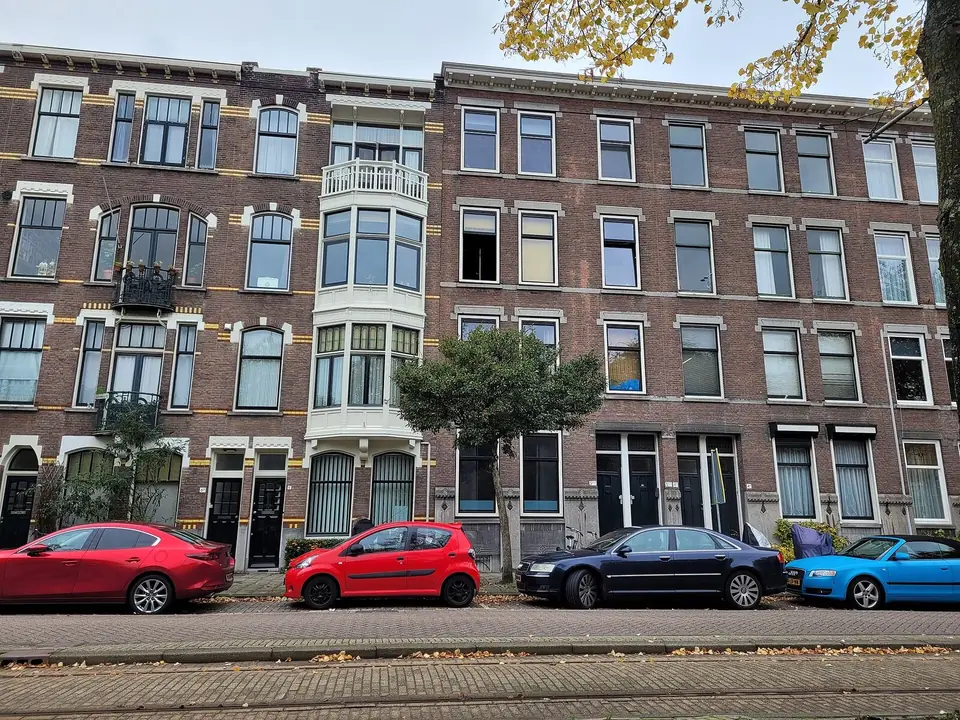

House prices in Rotterdam
The average existing home sold in Rotterdam in 2025 went for €414,579, 14% below the Dutch average of €479,527. That is 2.9% more than in 2024 and 35% more than in 2020.
The latest quarter, Q3 2026, averaged €443,134 over 2,041 sales, with prices 2.9% higher than a year earlier.
An average mixes flats and family houses, so it moves with what happened to sell. It tells you the level of the market, not what a particular home will cost.
| Year | Average sale price |
|---|---|
| 2015 |
€189,536
|
| 2016 |
€202,501
|
| 2017 |
€227,834
|
| 2018 |
€256,793
|
| 2019 |
€282,910
|
| 2020 |
€307,358
|
| 2021 |
€364,018
|
| 2022 |
€397,864
|
| 2023 |
€383,652
|
| 2024 |
€402,854
|
| 2025 |
€414,579
|
What buying the average home costs on top
At €414,579, the costs on top of the price come to about €11,457 for someone who will live in the home and borrows the full price with NHG, before the valuation, the adviser and any buying agent. A Dutch mortgage may not exceed 100% of the home's value (106% only to pay for energy-saving measures), so these costs normally come out of your savings.
| Transfer tax, 2% | €8,292 |
|---|---|
| Notary, both deeds (estimate) | €1,300 |
| Land registry, deed of transfer | €104 |
| Land registry, mortgage deed | €104 |
| NHG fee, if you use NHG | €1,658 |
| Total | €11,457 |
A buyer aged 18 to 34 who will live in the home and has not used the starter exemption before pays no transfer tax at this price, which brings the total down to about €3,165. A home you will not live in yourself, for example one you buy to let or for someone else, costs 8% transfer tax instead. Work it out for your own price.
Owning and renting in Rotterdam
35% of homes in Rotterdam are owner-occupied and 65% are rented, against 57% owner-occupied across the Netherlands. If you buy a flat you become a member of its owners' association (VvE), which maintains the building; ask for its reserve fund and maintenance plan before you bid.
The average WOZ value — the municipality's valuation, used for local taxes and in your tax return — is €342,000, against €398,000 nationally (Kerncijfers wijken en buurten 2025: the values for 2025 tax bills, which reflect prices on 1 January 2024). At the 2026 rate for owners of homes, 0.0643% of the WOZ value, the property tax (OZB) on a home of that value is about €220 a year (source). The 2026 bill itself is worked out on the home's value on 1 January 2025, which is shown on the municipality's WOZ decision.
Who lives in Rotterdam
Rotterdam had 673,804 residents on 1 January 2026. 15.9% of them have a non-Dutch nationality, against 9.3% across the country, 52,262 of them with the nationality of another EU country. Anyone with Dutch nationality, including people who also hold another, is not in that figure.
Buying a house in Rotterdam has three local angles worth knowing before you bid. Many homes stand on municipal land held in erfpacht (ground lease), and the city changed its leasehold policy on 1 January 2026. Sixteen neighbourhoods have buy-to-let protection. And the city has a starter loan on its books, although SVn stopped taking applications in 2025 and no longer listed it in October 2026.
Leasehold
With erfpacht you own the home but not the land under it, and you pay the municipality ground rent (canon) for using it. Your deed of transfer from the notary shows whether a home is on erfpacht. In Rotterdam the canon has often been paid in advance for 50 years; after that the contract continues and canon becomes payable. When a contract ends you never become owner of the land automatically: the municipality writes to you with your options.
Since 1 January 2026 a renewed policy applies to homes. The municipality states that:
- leaseholders who start a new erfpacht period on or after 1 January 2026 pay 25% less canon
- a new temporary contract runs for 50 years instead of 15
- leaseholders with temporary erfpacht get five years to buy their land for at most 60% of its value on 1 January 2024; if you apply yourself, you pay at most 75% of the current land value
For a new period, the canon is the land value times the canon percentage, which is 3.81% for 2026, less the 25% reduction: in the municipality's own example, a land value of €100,000 gives a canon of €2,858 a year.
The point that matters most at the moment of purchase is the HGW scheme (HGW-regeling), which lets a buyer prepay the canon for the whole erfpacht period on the basis of the historical land value. It is available if the canon was bought off for 50 years and those 50 years have not yet passed. You must apply within one, or sometimes two, months after buying; after that you cannot. If you use it, you can only buy the land after five years. Ask the seller's agent for the erfpacht deed early, and see our step-by-step guide to buying a house for where this fits.
Buy-to-let protection
Rotterdam has opkoopbescherming (buy-to-let protection) in 16 neighbourhoods: Bergpolder, Blijdorp, Bloemhof, Carnisse, Groot-IJsselmonde, Het Lage Land, Hillegersberg-Zuid, Hillesluis, Kralingen-Oost, Kralingen-West, Middelland, Nieuwe Westen, Oud-Charlois, Oud-Mathenesse, Rubroek and Tarwewijk. It covers homes transferred after 1 January 2022 with a WOZ value below €470,000 at the moment the transfer deed is registered, which were vacant, let for less than six months, or let with a permit at that moment. Under national law the ban lasts four years from that registration.
A rental permit is only granted in set cases, for example:
- letting to a relative in the first or second degree, such as a parent, child or sibling
- letting for at most 12 months, not as a holiday let, after you have lived there yourself for at least 12 months
- letting part of a home you live in yourself
- a home that is an inseparable part of a shop, office or business premises
The rules are in the Verordening samenstelling woningvoorraad 2025. Letting without a permit can lead to a fine of €8,000 for a first offence, rising to €21,750 from the fourth offence, and handling a permit application costs €327.70 in 2026. For new-build homes, the municipality already requires the buyer to live in the home.
Yearly charges for owners
The 2026 onroerendezaakbelasting (OZB, property tax) for owners of homes is 0.0643% of the WOZ value, or €64.30 per €100,000. Owners also pay rioolheffing (sewerage charge), a fixed €319.10 in 2026 (a lower €63.80 applies to properties with a WOZ value under €50,000, such as garage boxes). Every household pays afvalstoffenheffing (waste charge): €381.90 for one person, €457.50 for two and €495.30 for three or more. Rotterdam is served by three water boards, Schieland en de Krimpenerwaard, Delfland and Hollandse Delta; your address decides which one bills you.
Starter loan
The Verordening Starterslening Rotterdam is in force. It offers a starterslening (starter loan) of up to €30,000 through SVn to people aged 18 to 35 who live in Rotterdam, have a right of residence and have never owned a home in the Netherlands, for a home in Rotterdam costing no more than the NHG limit that they will live in themselves. The age limit does not apply if you are leaving a social rental home. Loans are only given while the budget lasts. In September 2025 SVn's page for the Rotterdam loan said no new applications could be made because the limit had been reached. By October 2026 that page had been taken down and SVn's loan finder listed no starter loan for Rotterdam, although the regulation itself is still in force, so ask the municipality whether it has reopened before you count on it. Our guide to NHG for expats explains the NHG limit.
Arriving in Rotterdam
If you stay in the Netherlands for more than four months, you make an appointment to register in person with the municipality where you will live, and you receive your BSN. The Rotterdam International Center, at Weena 725 in the Groot Handelsgebouw, offers a one-stop shop, for which it charges a fee, where you can book appointments to register with the municipality and receive your BSN and to collect your residence permit from the IND; it can also handle the full immigration and registration procedure for highly skilled migrants. See our guide to BSN and municipality registration.
Sources
- Gemeente Rotterdam: Erfpacht
- Gemeente Rotterdam: Opkoopbescherming
- Gemeente Rotterdam: Vergunning of toestemming opkoopbescherming aanvragen
- Lokale regelgeving: Verordening samenstelling woningvoorraad 2025
- Overheid.nl: Huisvestingswet 2014, article 41
- Gemeente Rotterdam: Belastingen
- Lokale regelgeving: Verordening onroerendezaakbelastingen 2026 (Rotterdam)
- Gemeente Rotterdam: Waterloket
- Lokale regelgeving: Verordening Starterslening Rotterdam
- SVn: Starterslening Rotterdam (archived September 2025)
- SVn: Leningzoeker (loan finder)
- Gemeente Rotterdam: First registration in the Netherlands
- Gemeente Rotterdam: Rotterdam International Center
Questions about buying in Rotterdam
Can I buy a house in Rotterdam and rent it out?
In 16 neighbourhoods, including Blijdorp, Kralingen, Middelland and Nieuwe Westen, a home with a WOZ value below €470,000 cannot be let for four years after the transfer without a permit. Permits are given in set cases, such as letting to a parent, child or sibling. Elsewhere in the city this rule does not apply, but new-build homes must be lived in by the buyer.
What should I check about erfpacht when buying in Rotterdam?
Check whether the canon is prepaid and until when, and whether the contract is temporary. Within one, or sometimes two, months of buying you can apply to prepay the canon for the whole period under the HGW scheme. Since 1 January 2026 the canon for a new period is 25% lower and leaseholders with temporary erfpacht can buy their land on better terms.
Is there a starter loan in Rotterdam?
Rotterdam's starter loan regulation offers up to €30,000 to residents aged 18 to 35 with a right of residence who are buying their first home, to live in themselves, at a price within the NHG limit, with no age limit for people leaving social rented housing. It depends on the budget: in September 2025 SVn said no new applications could be made, and in October 2026 its loan finder listed no Rotterdam starter loan, so ask the municipality whether it has reopened.
Where the figures come from
- CBS, Bestaande koopwoningen; gemiddelde verkoopprijzen, regio (updated 17 February 2026)
- CBS, Kerncijfers wijken en buurten 2025 (updated 15 October 2026)
- CBS, Kerncijfers wijken en buurten 2026 (updated 15 October 2026)
- CBS, Bevolking; geslacht, leeftijd, nationaliteit en regio, 1 januari (updated 7 July 2026)
- CBS, Bestaande koopwoningen; verkoopprijzen, prijsindex 2020=100, regio (updated 22 October 2026)
Read from CBS StatLine on 23 November 2026; refreshed every week.