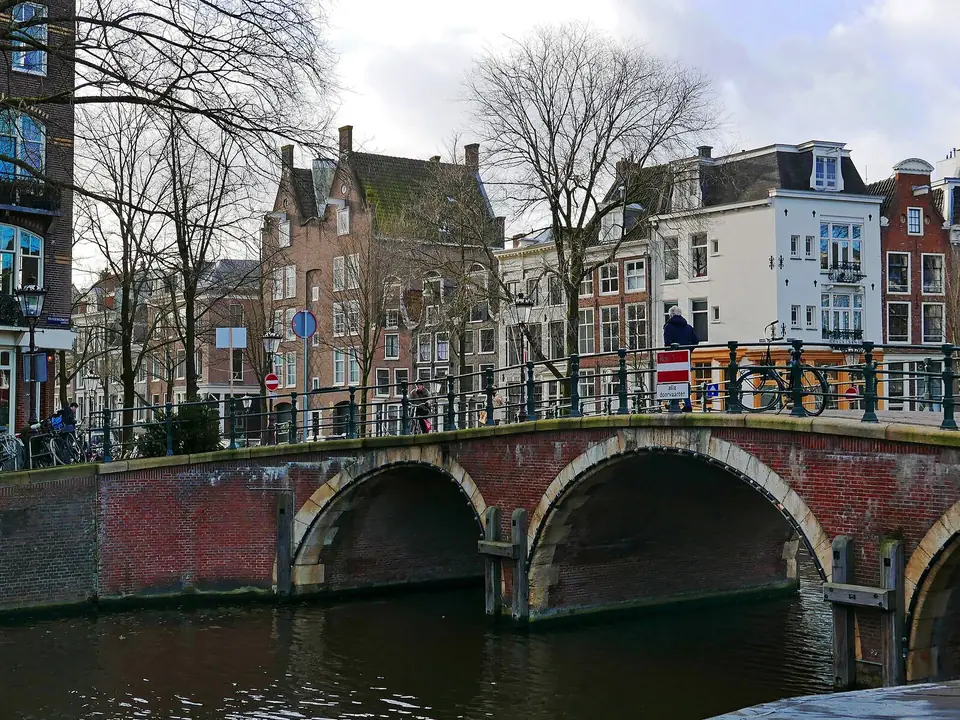

House prices in Amsterdam
The average existing home sold in Amsterdam in 2025 went for €630,621, 32% above the Dutch average of €479,527. That is 2.1% more than in 2024 and 23% more than in 2020.
The latest quarter, Q3 2026, averaged €649,427 over 3,842 sales, with prices 1.0% higher than a year earlier.
An average mixes flats and family houses, so it moves with what happened to sell. It tells you the level of the market, not what a particular home will cost.
| Year | Average sale price |
|---|---|
| 2015 |
€303,925
|
| 2016 |
€358,976
|
| 2017 |
€407,670
|
| 2018 |
€460,751
|
| 2019 |
€484,995
|
| 2020 |
€510,919
|
| 2021 |
€569,890
|
| 2022 |
€620,954
|
| 2023 |
€568,161
|
| 2024 |
€617,647
|
| 2025 |
€630,621
|
What buying the average home costs on top
At €630,621, the costs on top of the price come to about €14,119 for someone who will live in the home and borrows the full price, before the valuation, the adviser and any buying agent. A Dutch mortgage may not exceed 100% of the home's value (106% only to pay for energy-saving measures), so these costs normally come out of your savings.
| Transfer tax, 2% | €12,612 |
|---|---|
| Notary, both deeds (estimate) | €1,300 |
| Land registry, deed of transfer | €104 |
| Land registry, mortgage deed | €104 |
| Total | €14,119 |
The average is above the price limit for the starter exemption, so a buyer under 35 pays the 2% too on a home at this price. A home you will not live in yourself, for example one you buy to let or for someone else, costs 8% transfer tax instead. Work it out for your own price.
Owning and renting in Amsterdam
31% of homes in Amsterdam are owner-occupied and 69% are rented, against 57% owner-occupied across the Netherlands. If you buy a flat you become a member of its owners' association (VvE), which maintains the building; ask for its reserve fund and maintenance plan before you bid.
The average WOZ value — the municipality's valuation, used for local taxes and in your tax return — is €518,000, against €398,000 nationally (Kerncijfers wijken en buurten 2025: the values for 2025 tax bills, which reflect prices on 1 January 2024). At the 2026 rate for owners of homes, 0.0527% of the WOZ value, the property tax (OZB) on a home of that value is about €273 a year (source). The 2026 bill itself is worked out on the home's value on 1 January 2025, which is shown on the municipality's WOZ decision.
Who lives in Amsterdam
Amsterdam had 941,927 residents on 1 January 2026. 22.4% of them have a non-Dutch nationality, against 9.3% across the country, 99,930 of them with the nationality of another EU country. Anyone with Dutch nationality, including people who also hold another, is not in that figure.
Buying a house in Amsterdam means dealing with two local systems on top of the national rules. Most homes stand on municipal land held in erfpacht (ground lease), so the land has its own costs and conditions. And a cheaper home cannot simply be bought to let: for four years after the purchase you need a permit to rent it out.
Leasehold
Amsterdam has issued its land in erfpacht since 1896, and the municipality says the large majority of the city falls under it. You own the building and hold the right to use the land; for that use you pay ground rent (canon), unless it has been paid in advance (afgekocht, bought off). The right can usually be sold freely and a lender can take a mortgage on it.
Until 2016 almost every home was under voortdurende erfpacht (continuous ground lease), which runs in periods (tijdvakken). At the end of a period the canon is set again on the basis of the land value at that moment. Since 2016 the city also has eeuwigdurende erfpacht (perpetual ground lease), which has no periods.
Before you bid, find out three things: which of the two systems applies, when the current period ends, and whether the canon is bought off and until when. Our guide to erfpacht in Amsterdam explains each of them and how switching works.
The municipality also uses the erfpacht contract to steer how land is used. Among the examples it gives is a ban on letting (verhuurverbod) when new owner-occupied homes are issued, mainly aimed at investors. If you buy a new-build home, read the erfpacht conditions for that clause.
Buy-to-let protection
Amsterdam has had opkoopbescherming (buy-to-let protection) since 1 April 2022, in every district: Centrum, Nieuw-West, Noord, Oost, Weesp, West, Zuid and Zuidoost. Under the Huisvestingsverordening Amsterdam 2024, as it reads from 1 January 2026, it covers homes with a WOZ value of €637,000 or less when the transfer deed is registered at the Kadaster. It applies if, on that date, the home was vacant, had been let for less than six months, or was let with a permit. The city resets the limit every year in the regulation; €637,000 is the level from 1 January 2026.
For four years after registration you may not let a protected home without a permit or exemption. The permit is granted if:
- you let it to a relative in the first or second degree, such as a parent, child or sibling
- you have lived there for at least 12 months and then let it for at most 12 months, not as a holiday let
- the home is an inseparable part of a shop, office or business premises
A permit can also be given if you live in part of the home and let the rest. Separately, the college can grant an exemption, for example where it cannot reasonably expect the owner to comply; that is a case-by-case decision.
Some homes fall outside the scheme: homes on municipal land whose erfpacht conditions already contain a letting ban, homes completed after 1 April 2022 that were built or converted for rent, and homes sold as a block of ten or more in one building to a single buyer. If an employer might send you abroad within four years, ask about this before you buy.
Yearly charges for owners
The 2026 onroerendezaakbelasting (OZB, property tax) for owners of homes is 0.0527% of the WOZ value. On a WOZ value of €500,000 that is €263.50 a year. Owners also pay the fixed owner part of the rioolheffing (sewerage charge), €192.04 in 2026, and households pay afvalstoffenheffing (waste charge): €352 for a one-person household and €469 for larger households. Most of the city falls under Waterschap Amstel, Gooi en Vecht (AGV), but Amsterdam is also listed in the area of Hoogheemraadschap van Rijnland, so check which water board covers your address; it sends its own bill. The costs of buying calculator covers the one-off costs.
Starter loan
We found no municipal starter loan (starterslening) open for Amsterdam in 2026. The only Amsterdam starter-loan regulation on the official register dates from 2014. On 19 October 2026 SVn's loan finder, which lists the loans municipalities offer through SVn, showed no starter loan for Amsterdam either; check it again before counting on one.
Arriving in Amsterdam
If you move to the Netherlands for more than four months, you must register in the Basisregistratie Personen (BRP, the municipal population register), and that registration gives you your BSN. IN Amsterdam is a one-stop shop that combines first registration with the immigration procedure for eligible newcomers, such as highly skilled migrants, researchers and their families. It provides registration for Amsterdam, Amstelveen, Almere, Diemen, Haarlem, Haarlemmermeer, Hilversum and Velsen, and also has information on the 30% ruling. See our guide to BSN and municipality registration and the 30% ruling calculator.
Sources
- Gemeente Amsterdam: Wat is erfpacht
- Gemeente Amsterdam: Regels opkoopbescherming
- Lokale regelgeving: Huisvestingsverordening Amsterdam 2024 (version from 1 January 2026)
- Overheid.nl: Huisvestingswet 2014, article 41
- Lokale regelgeving: Verordening Onroerendezaakbelastingen 2007, Amsterdam (version from 20 December 2025, 2026 rates)
- Lokale regelgeving: Verordening Amsterdamse Rioolheffing (version from 22 November 2025)
- Lokale regelgeving: Verordening Afvalstoffenheffing en reinigingsrecht bedrijfsafval Amsterdam 2026
- Gemeente Amsterdam: Belastingtarieven 2026
- Waterschap Amstel, Gooi en Vecht: Werkgebied
- Overheid.nl: Hoogheemraadschap van Rijnland, area
- Lokale regelgeving: Verordening VROM Starterslening Amsterdam
- SVn: Leningzoeker (loan finder)
- I amsterdam: IN Amsterdam services for international newcomers
Questions about buying in Amsterdam
Can I rent out a house I buy in Amsterdam?
Not freely if its WOZ value is €637,000 or less when the transfer is registered. For four years you need a permit, which is given for letting to a relative such as a parent, child or sibling, for letting for up to 12 months after you have lived there for 12 months, or when the home is part of business premises. The college can also grant an exemption case by case. Homes on municipal land with a letting ban in their erfpacht conditions fall outside the scheme, because that ban applies instead.
Is most housing in Amsterdam on leasehold?
Yes. The municipality has issued its land in erfpacht since 1896, and it says the large majority of the city falls under it. Before you bid, check whether the right is continuous or perpetual, when the current period ends, and whether the ground rent is bought off and until when.
How much property tax do homeowners pay in Amsterdam?
In 2026 the owner's OZB is 0.0527% of the WOZ value, so €263.50 a year on a WOZ value of €500,000. Owners also pay a fixed sewerage charge of €192.04, households pay a waste charge, and the water board (for most addresses Amstel, Gooi en Vecht) sends its own bill.
Where the figures come from
- CBS, Bestaande koopwoningen; gemiddelde verkoopprijzen, regio (updated 17 February 2026)
- CBS, Kerncijfers wijken en buurten 2025 (updated 15 October 2026)
- CBS, Kerncijfers wijken en buurten 2026 (updated 15 October 2026)
- CBS, Bevolking; geslacht, leeftijd, nationaliteit en regio, 1 januari (updated 7 July 2026)
- CBS, Bestaande koopwoningen; verkoopprijzen, prijsindex 2020=100, regio (updated 22 October 2026)
Read from CBS StatLine on 23 November 2026; refreshed every week.